
Although the family hadn’t slept in the last twenty-four hours and the whole experience was taking on a vaguely hallucinogenic quality, the neighbors told them that there was a fiafia being held in their honor at the village of a Samoan teacher. Fiafia is a term used throughout Polynesia and is loosely translated as “the happy time.”
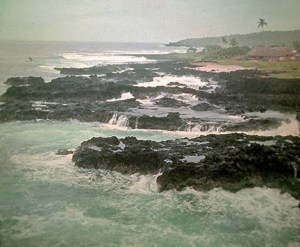 Jean could think of few things that would make her less happy than having to drag her four jet lagged daughters out into the pouring rain again, but clearly a lot of effort had gone into the party and it seemed rude to refuse. Twelve years of schooling by nuns had taught her manners, as well as the ability to spell. So they piled back into the assorted cars and jeeps that had brought them to their new home and set out for the village of Vaitogi.
Post 13 — A Village Called Vaitogi
Post 12 — A Village Called Tafuna
 Their new village was called Tafuna, and it combined the best of Samoan living with the worst of a suburban subdivision. The houses were all identical, shoebox shaped, like larger versions of Monopoly hotels. Instead of lining up along a nice geometric grid, they were scattered in every direction, as if an angry Polynesian player had flipped the board and all the neat little houses had ended up facing different ways. There were no streets or sidewalks or signs to distinguish where your house was; just some spotty grass and sand, white coral sand that had tiny shells hidden in it that came to the surface as rain poured off the eaves of the house. All the doors were painted aqua, gold or red.
“How are we supposed to remember which one we live in?” asked Carolyn.
“Well, find a blue door, go in and if you find other people with that haircut, then there you are,” said Larry.
Post 11 — Welcome to Samoa!
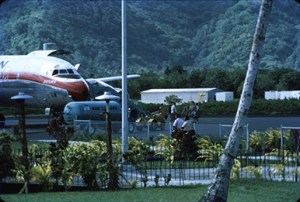
The airport at Tafuna. Photo by John Flanigan.
They walked across the tarmac, the older girls holding hands while Larry carried Karen, her thumb stuck deep in her mouth for comfort. The terminal was a surprisingly modern looking building with large windows that overlooked the runway, nothing like the primitive airstrip that they had been expecting. There was a large crowd of people waiting just outside the customs area, all of them laughing and waving and holding flowered leis, obviously there to meet one of the passengers. Carolyn and Kathy exchanged a look as they remembered their going away party and the paper leis Aunt Betty had made for them to wear. “Two years is a really long time,” Kathy whispered. Jean was thinking the same thing but gave her an encouraging smile, although it was just a little wobbly. Karen was too miserable to even whine.
We got off the plane feeling like hot, sticky loser orphans and dragged those damn umbrellas across to the clearance desk. I was going to bring some flower seeds in my luggage but it’s a good thing I didn’t. However if anyone should want to stick a few zinnias or marigolds into a letter, what the agricultural dept. doesn’t know won’t hurt them.
Post 10 — The Family Goes Even Wester
We rented a car and drove around Hawaii. Up mountain roads with palm trees and the water was any shade of blue from sky to royal to bright navy. It is horribly commercial and any relation to Michener-like descriptions are few and far between. Everybody was either old and wealthy-looking or young, tan and looking for action. The thing that struck us was that it was so quiet at the beach. Very few children. Later on when we were riding around we hit some stretches of beautiful big beach where the poor people go. They were a little noisier. There are many Orientals. Some look like they haven’t got a dime and others looked like James Shigeta and Nancy Kwan on location. As a whole, the mixtures come up with very attractive people. That little bit of information may not be new but it’s kind of interesting coming from one who is there instead of the National Geographic.
Jean
 Hawaii had been exotic and dreamy, but the family was getting anxious to see what the real destination would be like. The longest part of the trip turned out to be the last twenty-four hours. The baggage handlers in Honolulu were negotiating a new contract and the flight to Samoa had been delayed three times. The previous night had been mostly sleepless as the family tried to find places to stretch out at the airport, where the few available couches were covered in complaining tourists wearing shirts that they would be embarrassed to be seen in as soon as they got back to Ohio. The Broquet children were crabby and their parents exhausted as they all pined for the end of the journey, which had been accompanied by six awkward and bent umbrellas (200 inches of rain per year!). The plane finally left, nine hours later.
Chapter 2: Post 9 — The Family Goes West
The seven thousand mile journey had been an exciting one. The trip had taken a week with a few days each in California and Hawaii. Larry had cousins in Los Angeles so there was more family to visit there, and a long-promised trip to Disneyland finally came true.
 For children who had been thrilled with free cereal at the Kellogg’s factory, Disneyland was an experience they could barely imagine. The day was hot and sticky as they wandered through the theme park, gawking at costumed characters and hearing songs from all their favorite films. With “It’s a Small World” on a loop in their heads, the whole family boarded the boats for the Jungle Cruise.
Post 8 — Farewell to Harper Woods
Somehow everything got done. The packing was finished, the paperwork signed— all the steps necessary to walk away from an established life for two years. Larry was granted a leave of absence from the Detroit Board of Education so there would be job to come home to when the contract was up. But the hardest task of all was still ahead. It was time to say goodbye to the family.
The going away party was held in the backyard of Chuck and Betty Broquet, Larry’s brother and sister-in-law. It was the mother of all family parties, with every living relative within fifty miles of the Detroit Metro area invited. There were co-workers, friends, neighbors, and even Jean’s side of the family showed up for some uneasy cross socializing. There was a lot of potato salad.
Post 7 — Filariasis and vaccinations
 Larry and Jean went through the stack of National Geographics to try to find articles that would help them figure out exactly what they had signed on for. Aside from Margaret Mead’s Coming of Age in Samoa and some mentions in Tales of the South Pacific by James Michener, there just wasn’t that much written about the place.
Kathy brought the Michener book to the dinner table one night. “There’s a story in here about a man who had a disease called filariasis,” she said. “It says his scrotum weighed over seventy pounds and he had to carry it around in a wheelbarrow. Daddy, will we get filariasis? Where’s my scrotum?” They all turned expectantly to their father, who had gone even paler than the man with the wheelbarrow.
Post 6 — The Family Has Questions
As Jean had suspected, the news that four of the grandchildren were about to be whisked away to some unknown island was not met with much enthusiasm on the part of the grandparents. “What the hell are you going to Africa for?” her father shouted. “You don’t know what could be hiding in that jungle!” It was difficult to calm the parent’s fears when they knew so little themselves, although they were pretty sure the island wasn’t in Africa. Lack of information was a major problem — it wasn’t like they could just Google American Samoa and get all their questions answered.
Post 5 — The Decision
The Broquets were not big travelers. Larry had spent some Army time in Germany at the end of World War II and Jean had taken a cross-country bus trip to California, but that was about it. Their family vacations were the typical throw-all-the-kids-in-the-back-of-the-station-wagon kind to places within a few hours of Detroit.
 “Guess what we did,” Chrissie bragged to Debbie, Davey and Dawn. “We got to tour this big cereal factory in Battle Creek. They gave us little boxes of Fruit Loops and they were free! It was the best vacation ever!” They saw the tulips in Holland, rode the Boblo boat in Detroit, and actually left the country once to drive through the tunnel to Windsor, Canada. They bought some cheese and came home. It took about an hour.
Post 4 — The Father, Larry
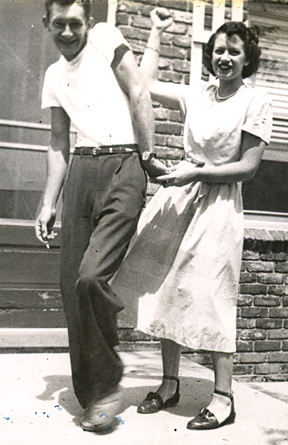 Larry Broquet taught geography and world history on educational television, WTVS Channel 56 in Detroit. ETV was a fairly new concept in the sixties and the station was producing original programming to be broadcast into classrooms. The information being taught was the same as in a regular school, but it was hard to hold student’s attention if you just stood in front of the camera and pointed to a map. Larry had always had a bit of a theatrical side and he put it to good use in his curriculum. He would write sketches that illustrated great moments in history and regularly worked costumes and props into his lessons. He also enjoyed using puns to make his point. One show about the Crusades ended with the punch line “I wouldn’t send a knight out on a dog like this” and involved a suit of armor and a live sheepdog in the studio. His program was very popular.
Post 3 — The Mother, Jean
 They were a rambunctious group, roughhousing like puppies and occasionally really beating the crap out of each other. The level of physicality might have seemed out of place in a house full of girls, but no attempt was made to force them to adhere to feminine stereotypes. The competitiveness was heightened by their perception of parental favoritism, something their mother and father were well aware of and determined not to encourage. Christmas gifts were presented in stacks of exactly the same number of boxes; each girl had an equal amount of socks in her drawer. The canned peas were counted and divided by four, regardless of whether or not anyone planned on eating them. Every child was equal in the Broquet household, and it occasionally drove them mad with fury.
Post 2 — The Family Broquet
Before the plane ride, before the packing, before the terror of the trolls, they were simply an ordinary family. A history teaching dad, a stay-at-home mom, and a bunch of kids who spent most of their days coloring pictures of apostles and learning how to spell from nuns.
Detroit in 1964 was still three years away from the riots that would paralyze the city, although racial tension was high and a long simmering resentment was building based on widespread reports of police brutality. The Detroit Tigers were in fourth place in the American League and the Beatles, fresh from their debut on the Ed Sullivan Show, would be playing Olympia Stadium in September. But for these children living in suburban Harper Woods, MI, life was as insulated as the plaid thermos of tomato soup that was tucked into their Flintstone’s plastic lunchboxes.
Chapter 1: Post 1 — The Terror of the Trolls
 As the Pan Am jet banked and began its descent, the girl pushed her slightly crooked bangs out of her eyes and stared out the smeared window, straining for a glimpse of her new home. The visibility was zero and since she couldn’t see anything below, she wondered how the pilot could. There was supposed to be land down there somewhere, but the shrouds of clouds that enveloped the plane seemed to have swallowed up the island as well. She rubbed the nubby fabric on her armrest nervously and touched the metal pair of wings that was pinned to her thin shift. The stewardess had told her that it made her an honorary pilot. She hoped that wouldn’t be necessary.
This is How You Begin
 The Samoan Letters started life as a four year correspondence from a family that had moved from suburban Detroit to American Samoa in 1964. Actually, it was my family, which is how I know all this stuff.
For the full story on that, check out Introduction – The Blook. If you’ve just found The Blook, go to Post One and wade right in. Or maybe you’ve been reading right along from the beginning, so just start with the most recent post. And if you’re feeling kind of non-linear, man, just start anywhere. You’ll catch up eventually.
New feature: The early chapters will start appearing as links at the top of the page so they can be read in sequence without scrolling (because we all know how exhausting that activity can be!)
Keep checking back on Fridays for new posts, and if you’re enjoying the story, please hit Like on the Facebook link on the right side and feel free to share. When it’s a movie, you’ll all have been responsible for helping it go viral and I will send each of you ten dollars. (Okay, that part is what we writers call “fiction.”)
All posts © Chris Broquet.
 The Samoan Letters