January 16, 2013
The students who attended the Dependent’s School were a mixed group. Most were the children of the teachers/principals who had been brought to the island by the United States government or offspring of other industry such as the Coca Cola Bottling Plant or Starkist Cannery. Classes were taught in English so most of the students were palagi, but there were also Samoan kids who had been educated on the mainland and had a good command of the language.
The proximity to the harbor was a huge distraction to the learning that was supposed to be happening in the classrooms. There was a constant stream of watercraft churning through the bay to the docks, from jerry-rigged fishing boats to majestic cruise ships. Giant metal cleats were cemented into the ground right outside the fourth grade building, and ropes as thick as a tuna fish were wound around them to anchor the huge boats.

Centipede Row, which was near the school, shows how close the harbour was to the buildings. This picture is actually from 1948, taken by Dr. Jim Harris, and can be found at http://jmflanigan.smugmug.com
read more »
Posted in Uncategorized |
2 Comments »
January 14, 2013
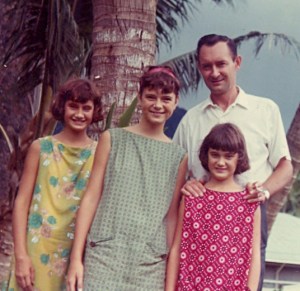 While Larry was off saving the Samoan population one toilet at a time, Jean was once more in charge of keeping the homefront on track. School had started for the three older girls, and this caused a flurry of activity as the household goods were still on a boat somewhere. Three outfits apiece were problematic when one had to go to school five days a week and there was no washing machine on the premises.
read more »
Posted in Uncategorized |
3 Comments »
January 9, 2013

Larry outside of a school in the village of Nua.
The camera was running and Larry called “Action!”. There was some confusion at first because no one knew what “Action!” meant, but eventually they sorted it out. Under his father’s direction, Solomon gathered up his soap and toothbrush that had been strategically placed by Larry and headed out of his fale to the communal shower. The village’s water supply came from the reservoir that was built up on the mountain, and the shower was basically a pipe that allowed a one-inch trickle of water to flow.
read more »
Posted in Uncategorized |
Leave a Comment »
January 6, 2013
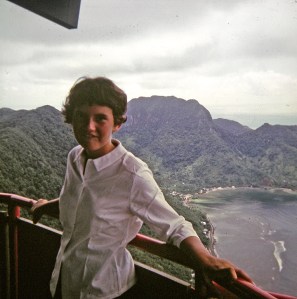
Carolyn ignores the view from the platform where the cable car passengers disembarked.
Governor Lee’s bold new idea had set off a building boom on the island. A new power plant had been constructed in 1961 to supply the electricity needed to run the televisions in each remote village. In order to broadcast the programming, a 40,000 watt transmitter had been constructed and lifted and then rebuilt on top of 1600 ft. Mt. Alava, assuring that the signal would reach the outer islands. They had even strung a mile-long cable car across Pago Pago harbor to allow engineers access to the giant antennae. The hike up the mountaintop to access the gondola was daunting, as was the trip across the harbor in a car that swayed and buffered as it zipped along a cable that was terrifyingly thin. But the view was spectacular.
read more »
Posted in Uncategorized |
Leave a Comment »
January 3, 2013

Larry shows his charismatic camera side while teaching proper toilet usage.
Larry was plunged into the chaos of the project with little training or warning. The four teachers who had been on the island for several months had a bit of a head start because at least they knew what subjects they would be teaching. Larry had taught World History in Detroit but there would be little need for that until students had mastered English and a few other basics. So after careful research and much discussion, he was given the responsibility of teaching a subject that many considered to be one of the most important in the curriculum: Hygiene and Sanitation.
This was deemed a major necessity because centuries of depending upon the tide to carry away sewage had caused environmental problems for the island, as well as comical incidents when the natives were faced with the prospect of using indoor plumbing. Workers at the new airport terminal reported finding rocks in the toilets, as this was the usual substitute for paper when one was going in the ocean.
read more »
Posted in Uncategorized |
1 Comment »
December 31, 2012
October 8, 1964
We have two channels operating at present and expect the third to be on shortly. Our building, the only air-conditioned structure on the island, is considered quite a showplace. Troops of visitors are constantly streaming in to examine the new wonder of video. The governor seems to show up about every second day to see what’s going on. I sometimes wonder if it’s us or the air- conditioning that attracts them.
Larry
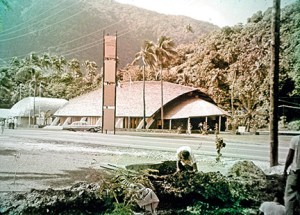
The H. Rex Lee auditorium, known to everyone as The Turtle.
The educational future of the children of a tiny Polynesian island was entrusted to two men from the landlocked center of America. The first was H. Rex Lee, a farm specialist who was plucked from potato-loving Idaho and appointed as governor in 1961. Lee championed the untested concept of televised teaching for the island and brought in Vernon Bronson to implement his program. The second was Michael J. Kirwan, the Democratic representative from Ohio who pushed through millions of dollars to actually fund the program. Kirwan’s son John was the assistant director of the U.S. Department of Interior office that was responsible for overseeing American Samoa, and got his father on board with the project. Each man was rewarded with an important building in Samoa named in their honor, yet if a tourist asked anyone on the island for directions to the H. Rex Lee Auditorium or the Michael J. Kirwan Studio, they would have been met with a blank look and a shrug.
read more »
Posted in Uncategorized |
2 Comments »
December 20, 2012

The brand new Datsun.
I can’t imagine how we got six people in this car.
Since he would soon be driving in this new place, Larry walked over to the police station to renew his driver’s license.
“Excuse me, I was told I need to take an examination to get a new driver’s license,” he said to the man at a desk.
“You new to the island?” asked a burly police officer who was wearing a khaki shirt and a lavalava with a tiny finger banana tucked in the waist.
“Just been here a few days,” said Larry, distracted by a loud conversation that seemed to be coming from the jail. “Is something going on over there?”
“Oh, no, it’s just lunch,” said the cop, peeling the banana and swallowing it in one bite. “The families of the prisoners bring them food.” He indicated a Samoan woman who was busy trying to push a papaya through the bars. From the amount of pressure being applied, Larry assumed that the fruit was going to pop and eliminate the need to be cut open. Amazingly, it didn’t, and the woman took out a machete and handed it to the prisoner.
“Do you mind if I ask what they did?” said Larry nervously. He had assumed the island would be devoid of murderers and crooks.
“Traffic violations. They all drive like crazy nuts. You want to take the test?”
read more »
Posted in Uncategorized |
Leave a Comment »
December 16, 2012
 Jean took the girls to their siva lesson while Larry left to do some shopping. In a small, wooden building next to the tourist office, a very large, smiling Samoan lady introduced herself as Tuli. The carb-laden diet of taro and breadfruit tends to produce a population that is quite heavy, but in Polynesia, big is beautiful. Jean compared her own ample figure to the woman in front of her and considered that she may have come across the perfect society. Tuli greeted the children and handed each of them a lavalava to tie around their waists. “I thought we would wear grass skirts,” said Carolyn doubtfully.
read more »
Posted in Uncategorized |
2 Comments »
December 12, 2012
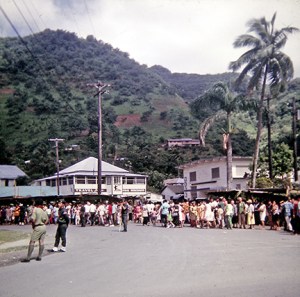
Downtown Fagatogo just before a parade broke out. There were LOTS of parades.
All over town there is hibiscus planted, and all sorts of green leaves and different colored-leaf plants. Everything has been planted and carefully cultivated and the jungle or vegetation is mostly palm trees, taro, banana plants and some vines & underbrush. We are eight miles out-of-town. All along the way are fales with the lavalavas all hung out. Some of the places look pretty junky but most of them are well-kept. It surprised me to see them along the paved road. I guess I thought they would be tucked away out of sight, but they were there before the road was and they didn’t bother to move.
Here and there along the ocean we would see a little walk built out and a little house at the end. They are the community johns. They open right into the ocean and the tide takes out all the waste and brings back nice clean water.
Jean
The village of Fagatogo was a jumble of old and new buildings that seemed to have every necessary service. There were three or four garages masquerading as stores, as well as a post office, jail, bank, tourist office, boat dock and movie theater. None of the businesses had signs, so it was fairly common for newcomers to head for the post office to drop off mail and accidentally wind up in the jail where the prisoners would lean through the bars and try to bum cigarettes off of them. Many of the structures were wooden and looked a bit shabby because the humidity and rain made most construction materials peel, rot or rust. Houses and fales were mixed in with the commercial establishments, and a large open grassy area called the malai functioned as the community’s front lawn. Parades and celebrations often took place there, as well as an occasional soccer game.
read more »
Posted in Uncategorized |
Leave a Comment »
December 9, 2012
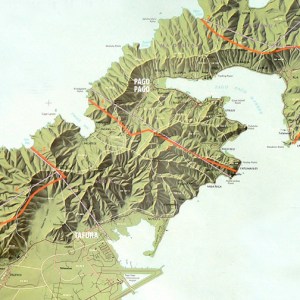
The route from Tafuna to downtown Fagatogo ran for seven miles along the edge of the island, with ocean on one side and mountain on the other.
After a few days, the family was beginning to feel a little more acclimated. Everyone had caught up on their sleep and the overwhelming sense of strangeness was starting to fade just a bit, although the children still kept trying to go into the wrong houses. School would not start for a few more weeks and the household goods weren’t expected until next month, so Jean was kept busy trying to keep the gang occupied with very few props. She thought about falling back on an old standby – mosaic pictures made out of dried peas and beans – but the cost of food was so exorbitant that it seemed wasteful. As an alternative, she signed the girls up for siva lessons so they could experience the culture firsthand.
read more »
Posted in Uncategorized |
3 Comments »
December 5, 2012
9/18
Lynn is our one hold out. She still gets a little mopey but she was doing that at home so I don’t think the change is her problem. I think it’s just being eleven and Kathy’s younger sister. They have done nothing but get on each other’s nerves. I had to separate them. Lynn is in with Karen now and so far it has been turning out pretty well; she seems a little gentler and more considerate of her since they have become roommates.
Jean

An overhead view of Tafuna.
Photo by David Gillmore.
“Has anyone seen the kids?” Jean asked the group that was sitting in lawn chairs in front of one of the houses, possibly hers although she wasn’t quite certain.
“Oh, they’re probably off playing in the banyan tree,” volunteered Mary, who was the mother of Liz, the Polynesian encyclopedia. Jean had no idea what a banyan tree was, but she didn’t feel it was necessary to volunteer that information. “Do you think we should go look for them?” she asked.
“Oh, they’re fine. There’s really nothing around here that they can get into that’s dangerous, so we let them roam pretty freely,” replied Mary, oblivious to the fact that at that very moment her children were considering jumping from the top of a forty-foot tree onto vines that may or may not have been connected to something. “Have you been into town yet?
read more »
Posted in Uncategorized |
Leave a Comment »
December 2, 2012

The author’s memory of what the tree looked like – not the actual banyan.
A banyan has a parasitic relationship with the jungle around it. The seeds take root in the crevices of high surrounding trees, deposited up there by helpful and/or incontinent birds. Because the light is better above the canopy, the roots grow quickly down from the top and eventually overpower and strangle the host like an over-served, psychotic guest run amok. This banyan had apparently crashed the party many years ago, because there was no sign of the original tree.
read more »
Posted in Uncategorized |
Leave a Comment »
November 28, 2012

Unfortunately, no pictures of the real banyan tree can be found. This is Kathy and friends in a different tree.
“Hey, do you want to go see the banyan tree?” A girl with blond hair almost as white as the sand tugged at Chrissie’s arm. The number of children milling about seemed far greater than the number of parents available.
“Um, sure. Let me go tell my mom.” Chrissie had no idea what a banyan tree was, but she didn’t feel it was necessary to volunteer that information. Her mother just waved at her and told her to have fun, deep in conversation with another mom about the fact that the freezer could hold fifty pounds of meat. Kathy saw them leave and hesitated, trying to decide if she should go explore with the children or stay with the adults. At twelve, she often felt torn between the two groups. But her interest in freezers full of meat was limited, so she grabbed Carolyn and they followed the other kids. Karen was busy digging in the sand so there was no need to restrain her.
read more »
Posted in Uncategorized |
2 Comments »
November 25, 2012
The kids have been very good … Periodic fights break out but that happened at home so I don’t suppose it means much. Karen has been crying, whining and being a miserable child but she was also like that at home. Our house is a joy, very large, airy and attractive. It will be some time before our household goods come so since everything is loaned there isn’t much convenience. Our one knife has a heavy wooden handle with a blade about twelve inches long with a good sharp point. So far we have hacked open a coconut, opened a can of milk, took the pins out of the door hinges (I locked myself out), pounded nails, cut bread, Spam, etc. and peeled potatoes. The other knife has a blade 16 inches long with a round end (they are called bush knives, and every Samoan over four years old has his very own – and we worried about penknives!) I haven’t found much use for this other than chasing the kids with it.
Jean

The village of Tafuna — Photo by David Gillmore
read more »
Posted in Uncategorized |
5 Comments »
November 21, 2012
Music is the backbone of the fiafia. Samoans grow up with music in their respective villages. Ukuleles and guitars are popular all over the island and even the little children manage to get something that sounds like music out of them. Once the music starts, the dancing is not far behind.
Larry
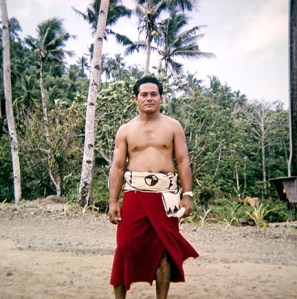 Although the weather raged outside, inside the fale it was dry and warm. A haze of pork-infused smoke wafted through the air, along with the occasional whiff of wet dog. The girls gawked at the Samoan men wearing lavalavas, a large rectangle of brightly printed cloth that wrapped around the body and knotted at the waist. The garment was well suited for the climate; it provided a breeze as well as easy access for the outhouses that stretched out over the reef. The women’s version of traditional garb was called a puletasi, which was a short-sleeved dress worn over a lavalava, usually all in the same print that had the unfortunate effect of making the wearer look a little like a large sofa. Long tables ran around the room, covered in banana leaves and set with plates that had been woven from the fronds of the versatile palm tree.
read more »
Posted in Uncategorized |
6 Comments »

 The Samoan Letters